 Voice
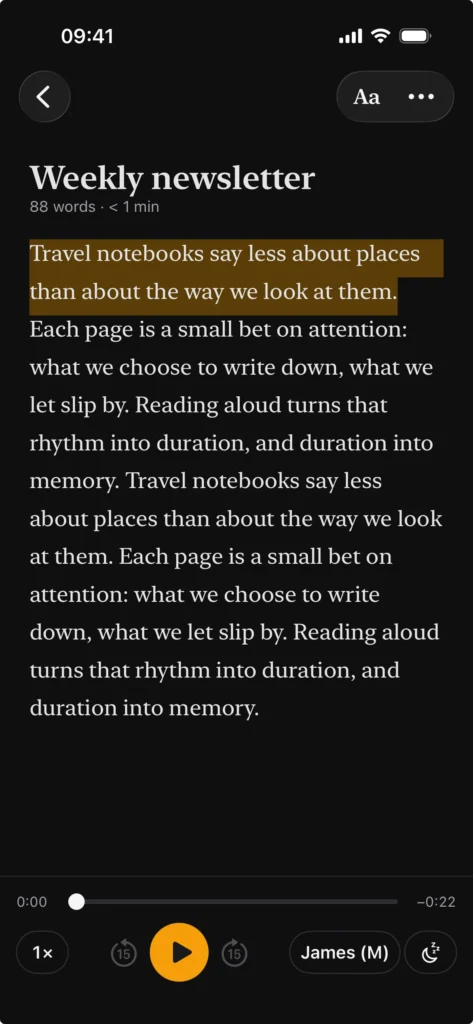
In short. Text to speech reads written text aloud, so people with dyslexia can follow the meaning without decoding every word. Hearing and seeing the words together, at an adjustable speed, makes long or difficult texts easier to take on.
Dyslexia is a common learning difficulty (NHS). For many people, reading printed or digital text is slow, exhausting, and frustrating — not because of a lack of intelligence, but because the brain processes written language differently. Letters may appear to move, words blur together, and sentences lose their meaning halfway through.
Text to speech (TTS) technology has emerged as one of the most effective tools for supporting dyslexic readers. By converting written text into spoken audio, TTS removes the decoding barrier and lets people focus on understanding content rather than struggling to read it. Here is how it works, which features matter, and how to use TTS effectively for dyslexia support.
How Dyslexia Affects Reading
Dyslexia is a neurological difference that primarily affects the ability to decode written language. It is not related to vision problems or intelligence. People with dyslexia often experience:
- Difficulty decoding words — Matching letters to sounds (phonological processing) requires significantly more effort, making reading slower and more tiring.
- Transposition and reversal — Letters like “b” and “d” or words like “was” and “saw” can appear interchangeable, causing confusion.
- Reading fatigue — The extra cognitive effort needed to decode text leads to exhaustion, especially during long reading sessions like studying or working through documents.
- Reduced comprehension — When most mental energy goes into decoding individual words, understanding the overall meaning of a paragraph or chapter suffers.
- Avoidance of reading tasks — Over time, the frustration of reading can lead to avoidance, which affects academic performance, professional growth, and self-confidence.
These challenges persist into adulthood. Dyslexia does not go away — but with the right tools and strategies, its impact on daily life can be significantly reduced.
How Text to Speech Helps Dyslexic Readers
TTS technology addresses the core challenge of dyslexia: decoding written text. Instead of relying solely on visual processing, TTS adds an auditory channel. This approach works for several important reasons.
Multi-sensory learning
When you hear a word spoken aloud while simultaneously seeing it on screen, two senses work together to process the information. This multi-sensory approach — combining visual and auditory input — strengthens word recognition and helps the brain form stronger connections between written words and their meanings. Over time, this can actually improve reading ability, not just compensate for it.
Reduced cognitive load
Decoding text is the bottleneck for dyslexic readers. TTS handles the decoding work, freeing up cognitive resources for comprehension. Instead of spending mental energy figuring out what each word says, the reader can focus entirely on understanding the content. This is especially valuable for academic texts, technical documents, and long-form reading.
Builds reading confidence
Many dyslexic readers develop anxiety around reading tasks after years of struggling. TTS provides a safety net — it ensures that the content is always accessible, regardless of difficulty level. Knowing that support is available encourages dyslexic readers to tackle more challenging texts and engage with reading more often.
Access to grade-level content
One of the most significant impacts of TTS for students with dyslexia is access to age-appropriate material. A child with dyslexia may read at a lower level than their peers, but their comprehension and intellectual ability are often at or above grade level. TTS bridges this gap by delivering content through audio, letting students engage with the same material as their classmates.
Key TTS Features for Dyslexia Support
Not every TTS solution is equally helpful for dyslexic readers. Certain features make a significant difference in usability and effectiveness.
Adjustable reading speed
The ability to slow down or speed up the voice is essential. Dyslexic readers often benefit from starting at a slower pace to follow along visually, then gradually increasing the speed as they become comfortable with the content. Some readers prefer faster speeds for familiar material and slower speeds for technical or new vocabulary.
Word highlighting
Synchronized word highlighting — where each word lights up as it is spoken — helps dyslexic readers track their position in the text. This visual guide reduces the chance of losing your place and reinforces the connection between the written word and its spoken form. It turns passive listening into active reading practice.
Natural-sounding voices
Robotic or monotone voices are harder to follow and more tiring to listen to over long periods. Modern AI-generated voices with natural intonation, pacing, and expressiveness make extended listening sessions comfortable. Natural voices also help with comprehension because they preserve the rhythm and emphasis of natural speech.
PDF and document import
Dyslexic readers encounter text in many formats — school worksheets as PDFs, textbook chapters, work documents, emails, and web articles. A TTS app that can import and read PDFs and other document formats eliminates the need to manually copy and paste text, making it practical for daily use.
Always one tap away
Reading support is more useful when it is one tap away wherever reading happens. With a library that remembers your place, imported documents stay available at school, on public transport or at home — the Resume button picks up where you stopped.
Using TTS for School, Work, and Daily Life
For students
TTS transforms the academic experience for dyslexic students. Textbook chapters, assigned readings, handouts, and exam materials can all be imported and listened to. Students can review material multiple times by listening at different speeds, and they can study independently without needing someone to read aloud for them. Many schools and universities formally recognize TTS as an approved accommodation for dyslexia.
For professionals
In the workplace, dyslexic professionals face a constant stream of emails, reports, proposals, and documents. TTS allows them to process this information efficiently without the fatigue of extended reading. It also helps with proofreading — hearing your own writing read back to you makes errors much easier to catch.
For daily life
Beyond school and work, TTS helps with everyday tasks that involve reading: news articles, recipes, instruction manuals, official correspondence, and personal reading for pleasure. Instead of avoiding these tasks or taking disproportionate time to complete them, TTS makes them manageable and even enjoyable.
Voice Reader AI by Tissyo Features for Dyslexic Readers
Voice Reader AI by Tissyo runs on iPhone, iPad and Mac. Here is what dyslexic readers can do with it:
- Resume — The library’s Resume button restarts playback where you stopped.
- PDF import — Voice Reader AI by Tissyo reads PDFs that contain text. It does not recognise scanned pages or photos: extract the text first (for example with Live Text on iPhone), then paste it into the app.
- Adjustable speed control — Slow down for difficult passages or speed up for review. Find the pace that works for you and change it anytime.
- Natural AI voices — French and English voices (US and UK accents), all with natural intonation that is comfortable for extended listening.
- Web article extraction — Save articles from the web and listen to them later.
- Cross-device sync — Start reading on your iPhone and continue on your iPad or Mac. Your library and progress sync via iCloud.
- No subscription — 14-day trial, then a one-time purchase with updates included. No monthly fees, no usage limits, no recurring charges.
Frequently Asked Questions
Does text to speech help with dyslexia?
Yes. Text to speech supports dyslexic readers by providing an audio version of written text. Hearing words while seeing them on screen creates a multi-sensory reading experience that strengthens word recognition, reduces decoding effort, and improves comprehension. TTS can help dyslexic readers access grade-level content they would otherwise struggle with.
Can children with dyslexia use text to speech apps?
Absolutely. TTS apps like Voice Reader AI by Tissyo are suitable for children and adults alike. Children can import school PDFs, textbooks, or reading assignments and listen along at their own pace. Adjustable reading speed lets them slow down for difficult passages and speed up for familiar content, building reading confidence over time.
Can I adjust the display for dyslexia?
Yes. With Voice Reader AI by Tissyo, the “Aa” button sets text size and line spacing, three themes (light, dark, sepia) let you choose the most comfortable display, and the sentence being read stays highlighted.
Sources
The NHS describes dyslexia as a common learning difficulty that mainly affects reading and writing and does not affect intelligence (NHS, Dyslexia). A meta-analysis of 22 studies found a modest positive effect of text-to-speech and read-aloud tools on reading comprehension for students with reading disabilities (Wood et al., Journal of Learning Disabilities, 2018).