 Interact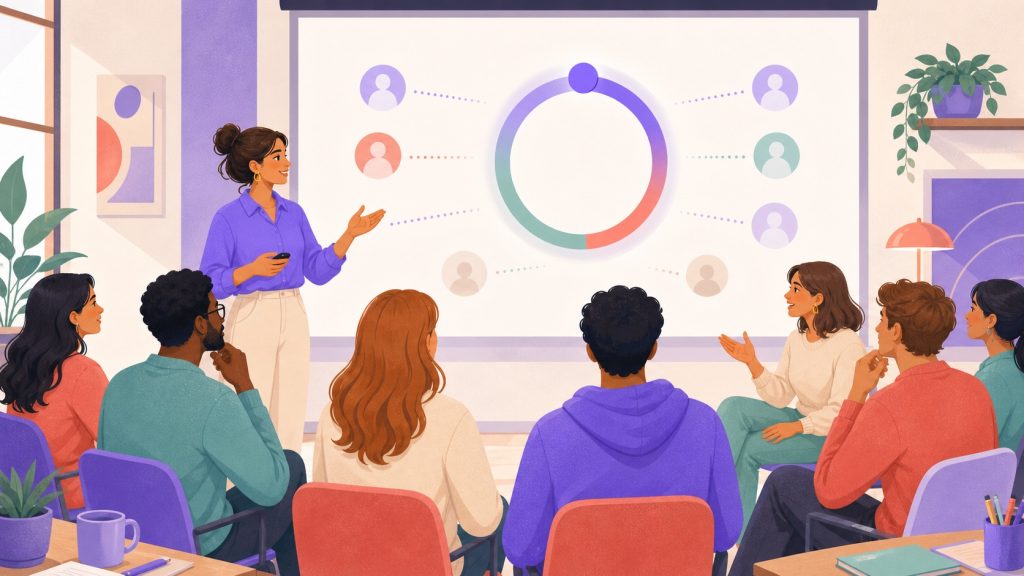
You know the scene. You throw out an open question, and it is always the same three who answer. The others nod, take notes, stay quiet. It is not bad will: it is the natural mechanics of a group, where a few confident voices fill the space while the rest wait for an opening that never comes. Managing speaking time is not about timing each person to the second. It is about designing your session so that speech circulates instead of concentrating. Here are the concrete levers we see working, and how to support them without weighing down your facilitation.
Why speaking time always lands on the same people
In any group, speaking follows an implicit law: whoever speaks fastest owns the floor. People at ease out loud answer within a second, before the others have even finished forming their thought. As a result, the more reflective or reserved participants quickly learn that jumping in is pointless: the spot is already taken. This is not a matter of ability or interest, but of pace and format.
The good news is that this imbalance is structural, so it can be repaired by structure. If you change the way speech is distributed, you change who speaks. Three families of levers are enough: make time visible, alternate formats, and remove the choice of "who speaks" from anyone’s hands by using chance. Let us look at them one by one.
Making time visible: the projected timer
The first reflex is to get time out of your head. As long as the countdown lives in your watch or your gut, each participant improvises their own duration: some stretch, others rush. A timer projected on screen puts everyone on the same page without you having to interrupt. Each person sees how much is left, self-regulates, and you are no longer the timekeeping police.
In practice, announce "two minutes each" and start the visible countdown. The person speaking watches the time run down and wraps up on their own; the one waiting knows exactly when their turn comes. This simple move defuses monologues and reassures the more reserved, who often dread "taking up too much space". We cover the uses in the projected timer, but the principle fits in one sentence: what is visible is shared.
What is visible is shared. Time on screen stops being your responsibility and becomes the group's.
Alternate spoken and written to open a second channel
Speech favours the quick. Writing favours the reflective. If you only ever go through the spoken word, you only hear half the group. By slipping in written moments, you open a second channel where quiet participants finally exist: a poll, a word cloud, an idea wall where everyone contributes at once, without having to cut anyone off.
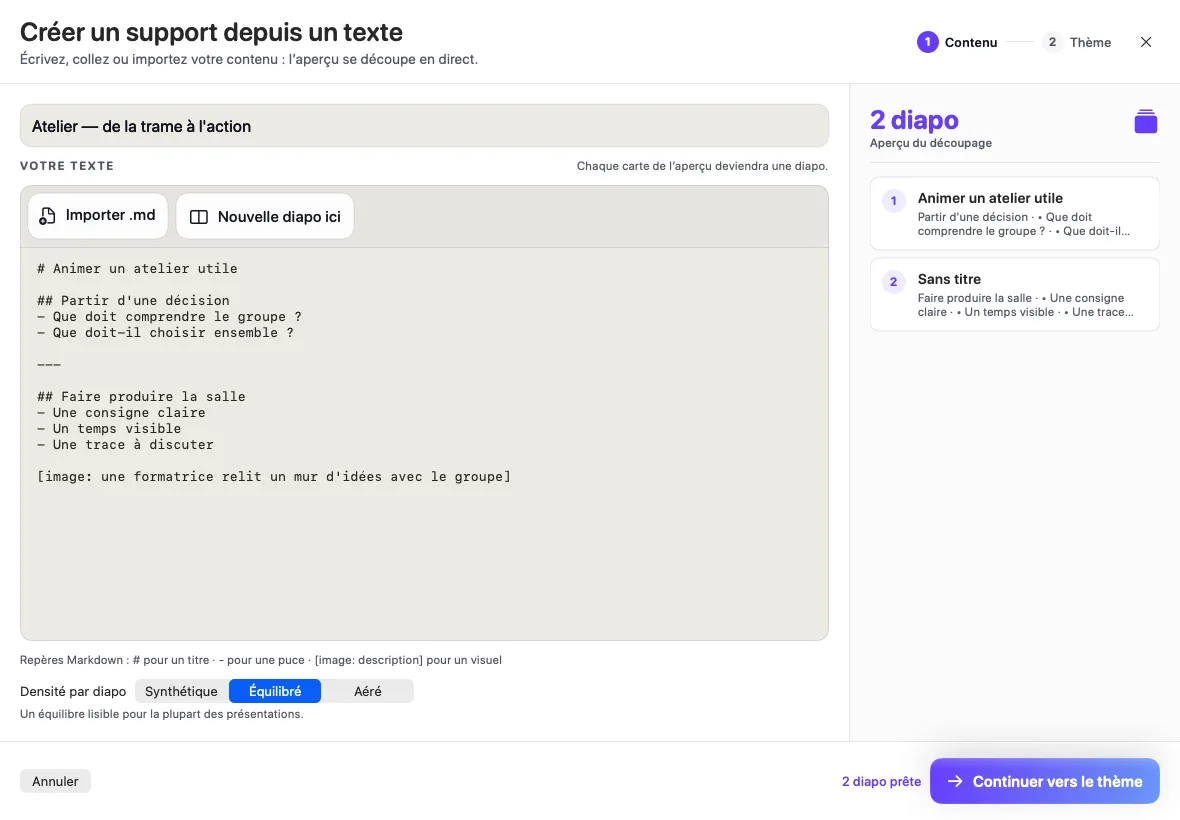
The most effective trick has two beats: first an individual written moment where each person drafts their answer on their phone, then a round of speaking where you comment on what appeared. Because the ideas are already down, even those who dare not launch a sentence cold have something to defend. Participants join with a simple QR code, no app to install and no account to create. This is the heart of our approach to getting a silent class to participate.
- An anonymous poll to take the temperature without exposing anyone
- A word cloud to surface impressions in ten seconds
- An idea wall to gather proposals in parallel, not one at a time
- An open written question before the debate, so everyone has a stance to defend
Draw at random: take the choice of who speaks out of anyone's hands
The gaze that sweeps the room looking for "someone willing to answer" always ends up on the same faces. A random draw breaks that reflex. By picking at random who speaks, you remove both the facilitator’s bias and the anxiety of volunteering: no one has to put themselves forward, so no one is judged for offering or for staying silent.
Done well, a random draw is not a punishment, it is an invitation. Warn the group that anyone can be called: everyone stays alert and mentally prepares an answer. You often discover that the quietest participants have fascinating things to say, once the barrier of "daring to raise a hand" disappears. See how we support it in the random draw.
A random draw does not punish silence; it removes the courage needed to break it.
Assign a role: give responsibility rather than force
When a participant has a clear role, they speak without being pushed. Give the summary to one, the devil’s advocate to another, the timekeeping to a third. Each knows why they are stepping in, and that legitimacy is worth a thousand words of encouragement. A role turns "I am not sure I am allowed to speak" into "it is my job to speak now".
Roles are especially useful in small-group formats, where you can rotate functions from one activity to the next. Over a day, make sure everyone has held the spokesperson role at least once: that is often the moment a reserved participant catches themselves enjoying speaking up. Combine this logic with varied formats, as we explore on the active learning side.
Put it all together without becoming a conductor
These four levers reinforce each other: a written moment prepares speech, the random draw distributes it, the role legitimises it, the timer bounds it. The risk is juggling too many tools and losing the thread of your facilitation. That is why Tissyo Interact brings together, in a single session, your slides, a projectable timer, an iPhone or Watch remote to steer without going back to your Mac, and 14 interactive activities that participants join by QR code.
On privacy, your data stays on your Mac: we keep nothing on our servers. The free plan is very generous, with just a monthly cap on interactive activities; the Pro plan is €9.99/month or €79.99/year in France (the exact price for your country is shown in the Mac App Store) if you facilitate often. Enough to rebalance the airtime of your next session without switching tools halfway through.
Frequently asked questions
Won't a random draw stress the shyest people?
Not if it is announced and framed. Warn that anyone can be called and that passing is allowed. Preceded by a written moment where each person has already drafted their answer, the draw becomes an invitation to share something prepared, not a surprise interrogation.
Do I really have to time every contribution?
No, the goal is not to count seconds. A projected timer mainly serves as a shared reference: everyone sees the time left and self-regulates. You no longer have to interrupt, which is far more comfortable for you and for the group.
Do participants need to install an app?
No. They join each activity by scanning a QR code, with no app to install and no account to create. That is what makes written moments so quick to launch, even with a group that does not know you.
Do these methods work online as well as in person?
They are designed first for in-person settings, where the projected screen and QR code shine. The principles hold everywhere, though: making time visible, alternating channels and taking the choice of who speaks away from the group rebalances speaking time in any context.