 Interact
A poorly framed debate means three people talking loudly while the room drifts off. A well-orchestrated one means an opinion forming, clashing, and sometimes shifting, in front of everyone. The difference is not your charisma; it is the structure. Poll opinion before, have groups build their arguments, re-vote after, and project the movement. Your job is no longer to convince, but to orchestrate. Here is the method, step by step, with concrete facilitation moves.
Why the classic debate so often falls flat
The "who wants to react?" format always favours the same voices. The most confident participants dominate, the rest stay silent, and by the end nobody really knows what the group thought at the start or what it thinks by the finish. The debate becomes a show, not a learning moment.
The problem is not the topic, it is the lack of measurement. With no starting point and no finishing point, you cannot observe any shift. Yet that shift is exactly what makes a debate memorable: "I was against it at first, and in the end the other group’s argument made me hesitate." To capture that, frame the debate as an experiment, with a before measure and an after measure.
Step 1 — Poll opinion before (the baseline)
Before any exchange, ask a binary question or a position scale on a divisive statement: "Remote work harms team cohesion: rather agree or rather disagree?" Participants answer by scanning a QR code, no app and no account, and the result appears on screen within seconds. You now have your baseline. This first vote also has a psychological benefit: everyone has taken a stance, so everyone is invested in listening to what comes next.
This opening poll is the foundation of the whole sequence. If you want to dig into the mechanics of projected voting and its variants, live polling is worth a look: anonymity, controlled reveal, and choosing the right question type for what you are trying to measure.
Step 2 — Form the camps and start the argument phase
Two options depending on your intent. Either let everyone defend their genuine position, or assign camps at random, including the opposite of their view. That second approach is often the most instructive: defending an idea you do not share forces you to understand the opposing argument from the inside, which defuses posturing. Split the room into two physical zones and give five to ten minutes of small-group preparation.
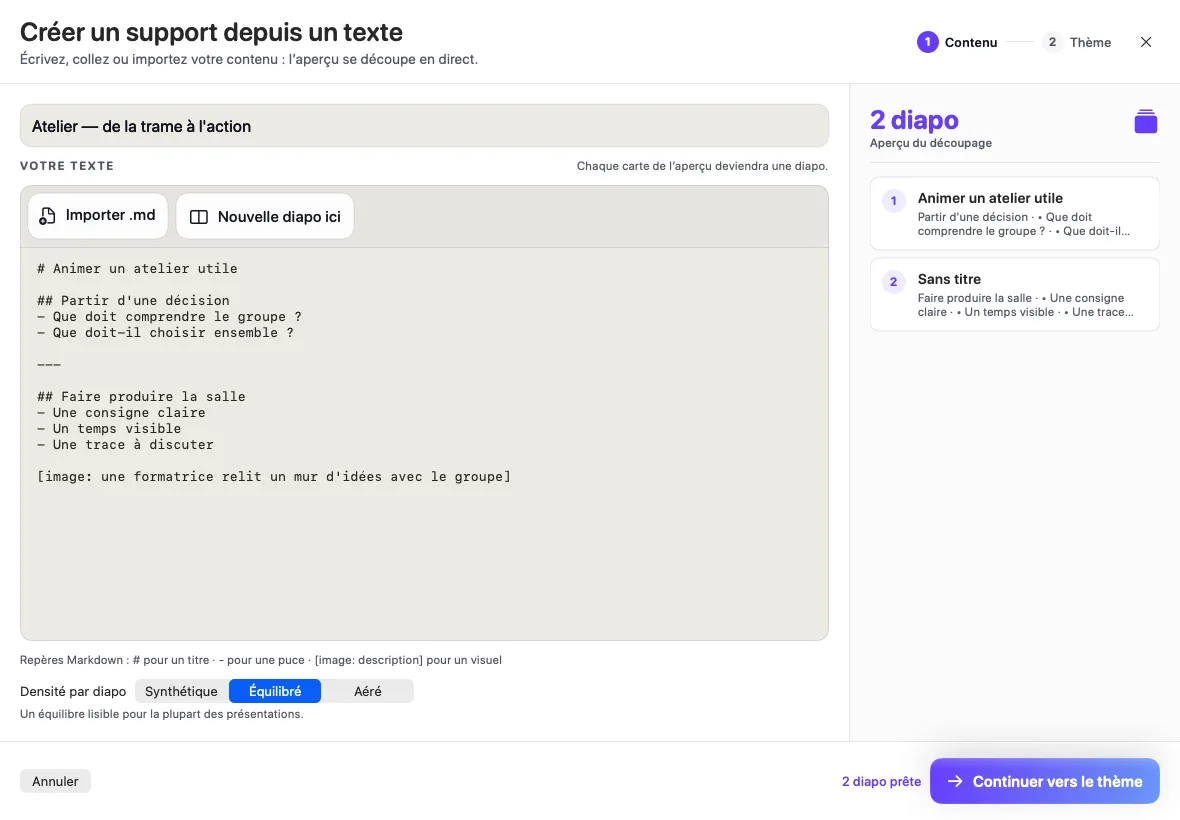
During preparation, each camp lists its strongest arguments. You can surface those arguments on screen to build a shared, visible base, just like an idea wall: everyone contributes from their phone, the suggestions appear, and the debate that follows rests on something concrete rather than on improvisation.
- Free-choice camps: ideal when the topic touches lived experience and authenticity matters.
- Random camps: ideal for critical thinking, forcing a change of perspective and preventing the debate from collapsing into pre-existing beliefs.
- One neutral observer per group: they note the strongest arguments and deliver the summary, which gives a role to those who speak little.
- Framed speaking time: two minutes per camp then a follow-up, rather than a free-for-all where the loudest take everything.
Step 3 — Orchestrate the exchange, do not win it
This is where your posture changes. You are neither judge nor participant: you are the metronome. You alternate who speaks, you rephrase the fuzziest arguments, you follow up when a camp weakens, and above all you keep the time. A projected timer visible to all transforms the dynamic: no need to say "let’s speed up," the countdown does the work for you and nobody feels arbitrarily cut off.
Keep one simple rule: every contribution must add an argument, not repeat the previous one. When someone merely agrees, send them back to a fresh argument. This light framing is enough to raise the level without you ruling on the substance. Your neutrality is your best tool: it lets anyone change their mind without losing face.
The facilitator does not win the debate. They make it measurable, then step aside.
Step 4 — Re-vote after (the moment of truth)
Ask exactly the same question as at the start. Participants vote again, and you display the initial vote and the final vote side by side. This is the strongest moment of the sequence: the shift in positions becomes visible, quantified, undeniable. Sometimes the room swings sharply, sometimes it moves by a few points, sometimes it does not move at all — and that is just as interesting to discuss.
This result opens the real conversation: what made you change? Which argument carried weight? Those who did not move, why not? You move from raw opinion to metacognition, that is, awareness of how one forms a view. That is where the debate becomes a transferable skill, not just a pleasant moment.
What you need for it all to flow
The method has four beats, but it assumes the tools do not slow you down. Poll, project, time, gather contributions, re-vote: if each step needs a different piece of software, you lose the thread of the facilitation. Tissyo Interact brings the whole session into one place — your slides, 14 interactive activities including polling and the idea wall, the projected timer, and an iPhone or Watch remote to run things without staying behind the keyboard. Participants join by QR code, with nothing to install.
On privacy, it is clear: your data stays on your Mac and we keep nothing on our servers. Running a debate on a sensitive workplace topic? The answers do not end up in a third-party cloud. You can test the whole mechanic — poll, debate, re-vote — from the free plan, which stays very generous, then move to Pro at €9.99/month or €79.99/year in France (the exact price for your country is shown in the Mac App Store) if you facilitate regularly.
Frequently asked questions
Should I assign camps at random or let people choose?
Both work, depending on your goal. Random assignment builds critical thinking by forcing people to defend a position they do not hold; free choice favours authenticity and personal engagement. With adult audiences, random assignment often surprises pleasantly and breaks rigid postures.
How do I measure whether the debate really shifted positions?
Ask the same question before and after, then display both votes side by side. The shift becomes visible and quantified. Even an absence of movement is interesting: it points to solid convictions that are worth making explicit.
How much time should I allow for a structured debate?
Plan for roughly twenty-five to thirty-five minutes: two to three minutes for the initial vote, five to ten minutes of group preparation, ten minutes of exchange, then the re-vote and its discussion. A projected timer helps enormously to hold this pace without cutting people off abruptly.
Do participants need to install an app to vote?
No. They scan a QR code shown on screen and answer from their browser, with no account and no installation. That is what lets you poll opinion within seconds, both at the start and at the end of the debate.